<p>In 2019, 2011 and 2012, scientific researchers from the Xinjiang Institute of Ecology and Geography of China Academy of Sciences collected soil topsoil samples in Kazakhstan, Kyrgyzstan, Uzbekistan and Tajikistan, and analyzed and tested the content of soil metal and non-metallic elements according to ICP soil determination methods and standards, including 20 elements including Al, Ba, Be, Ca, Co, Cr, Cu, Fe, K, Li, Mg, Mn, Na, Ni, P, Pb, Sr, Ti, V and Zn. The data reflects the element combination and distribution characteristics of the surface soil. </p>
| collect time | 2009/01/01 - 2012/12/31 |
|---|---|
| collect place | Kyrgyzstan, Eastern Kazakhstan, Tajikistan, Uzbekistan |
| data size | 653.9 KiB |
| data format | .xls |
| Coordinate system | |
| Projection | no |
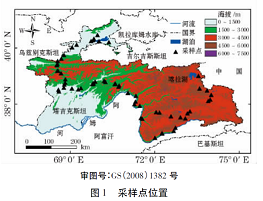
From September to October 2011, the inland lakes, rivers and mountains of the Pamir Plateau in western Tajikistan, the Amu Darya River and its tributaries in the southwest, the northern plain area, and the eastern plains and mountains were inspected and collected on the surface layer (top 1 cm) soil, river bottom sand, lake sediments or bedrock. See Figure 1 for the locations of the sampling points:
Figure 1: Sampling point location diagram
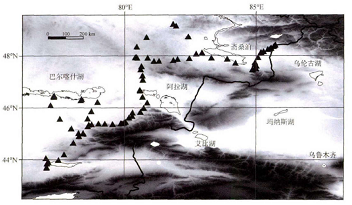
In June 2012, an inspection was carried out in eastern Kazakhstan and 82 samples of surface soil were collected. This area belongs to East Kazakhstan and Almaty Oblast. It is an industrially developed area of Kazakhstan and an economic zone dominated by non-ferrous metal mining, smelting, hydropower generation and livestock product processing. See Figure 2 for sampling point locations.
Figure 2: Schematic diagram of sampling point locations in eastern Kazakhstan
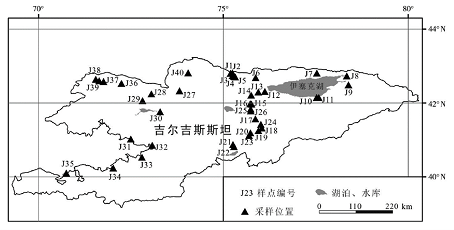
In 2012, a scientific investigation was conducted in Kyrgyzstan, and a total of 40 topsoil samples were collected in three different environments: highways, farmland and rivers. See Figure 3 for the locations of sampling points.

Figure 3: Schematic diagram of sampling point locations in Kyrgyzstan
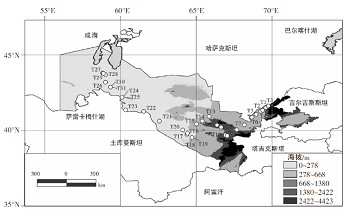
In 2009, a scientific survey of different geomorphological units of Uzbekistan was conducted from the capital Tashkent to the Aral Sea. During the inspection, both convenient transportation and ensuring the collection of different types of soil were taken into account. The focus was on inspecting soil distributed at different altitudes in the Amu Darya River Basin and different types in the Aral Sea Basin. A total of 31 different types of surface soil samples were collected from 28 points. See Figure 4 for the location of the sampling points.
Figure 4: Schematic diagram of sampling points in Uzbekistan
After freeze-drying, all collected soil samples were ground to 200 mesh, dried in an oven at 105℃, 0.120 - 0.125 g of samples were taken into a nitrification tank, 0.5 mL of hydrochloric acid, 4.0 mL of nitric acid and 3.0 mL of hydrofluoric acid were added, and nitrated in a Berghof MWS-3 microwave nitrification system in Germany. After naturally cooling, transfer it to a polytetrafluoroethylene beaker, add 0.5 mL of perchloric acid and evaporate to dryness, then add 5 mL of 1:3 nitric acid, 0.1 mL of hydrogen peroxide and a small amount of deionized water, and heat to dissolve the residue. After cooling, the volume was constant to 25 mL, the solution was transferred to a polyethylene bottle and stored at 4℃. The concentrations of each chemical element were measured using Leeman Labs Profile ICP-AES(Inductively Coupled Plasma Atomic Emission Spectrometer) in the United States. After freeze-drying soil samples collected in Tajikistan, the contents of 17 elements, including Al, Fe, Ca, Mg, Ti, Co, V, Cr, Sr, Cu, Zn, Mn, Ni, P, Na, Pb and Cd, were determined. After freeze-drying of soil samples from Kazakhstan, the contents of 20 elements including Al, K, Ti, Be, Ba, Fe, Co, Mg, V, Li, Cr, Mn, Na, P, Ni, Zn, Cu, Sr, Ca and Pb were determined. After freeze-drying of soil samples from Kyrgyzstan, the contents of 20 elements including Al, Fe, Ca, Li, Na, K, Mg, Ti, Co, V, Cr, Be, Ba, Sr, Cu, Zn, Mn, Ni, P, and Cd were determined. After freeze-drying of soil samples from Uzbekistan, a total of 19 elements including Al, Fe, Ca, Na, K, Mg, Ti, Co, V, Cr, Be, Ba, Sr, Cu, Zn, Mn, Ni, P and Cd were determined. Among them, Cd was below the detection limit and was not detected.
Laboratory analysis of all collected soil samples uses the American CertiPrePTM Custom Assurance Standard multi-element standard solution and the China System Sediment Composition Analysis Standard Material GBW07311 as the reference standard, and the parallel analysis error is less than ±5%.
| # | number | name | type |
| 1 | 2010DFA92720 | Central Asia | International cooperation project of the Ministry of science and technology |
This work is licensed under a
Creative
Commons Attribution 4.0 International License.
| # | title | file size |
|---|---|---|
| 1 | 2009年乌兹别克斯坦土壤元素数据.xls | 35.5 KiB |
| 2 | 2009年乌兹别克斯坦表层土壤采样点信息.xlsx | 10.7 KiB |
| 3 | 2011年塔吉克斯坦土壤元素数据.xls | 108.0 KiB |
| 4 | 2011年塔吉克斯坦土壤采样点信息.xlsx | 11.7 KiB |
| 5 | 2012年吉尔吉斯斯坦土壤元素数据.xls | 40.0 KiB |
| 6 | 2012年吉尔吉斯斯坦土壤采样点信息.xlsx | 9.7 KiB |
| 7 | 2012年哈萨克斯坦东部土壤元素数据集.xls | 58.5 KiB |
| 8 | 2012年哈萨克斯坦东部土壤采样点信息.xlsx | 12.0 KiB |
| 9 | 采样点矢量数据.zip | 367.9 KiB |
©Copyright 2021-. Xinjiang Institute of Ecology and Geography, CAS
No. 818 Beijing South Road, Urumqi, Xinjiang, China, 830011